

Is Your Startup Running Out of Cash, or Are You Failing to Say No?

Ask a founder what killed their failed company and you’ll usually hear “we ran out of money.”
To me, statements about running out of money are true the way ‘his heart stopped’ is true.
The better question is what happened in the 18 months before that?
Which decisions came late, which priorities never got actioned and what should have been stopped, and which problems kept routing through one overloaded founder or founding team?
Cash isn’t only spent on payroll and cloud bills. Every yes you give is also a bank withdrawal. You’re an entrepreneur! You’re keen to change the world! So you say yes to the custom feature for one customer. Yes to the investor’s side project. Yes to the meeting, yes to the pitch competition, yes to the hire you weren’t sure about.
But each yes costs time, focus and runway, and they won’t show up on a balance sheet until it’s too late.
So here’s a self-diagnostic. Failing to say no shows up in four ways, and each needs a different fix. Some of these are hard decisions to make, but business survival is hard, and this is the entrepreneur’s job - your job.
1. You say yes to everything, so nothing is a priority
Can you name your top three priorities this quarter in 30 seconds?
And could you name what you’re deliberately going to stop doing?
If the second list is harder than the first, this is your problem. Without a clear “stop doing” list, priorities stack up into a longer to-do list which confuses and distracts your team.
Tool: Eisenhower Matrix
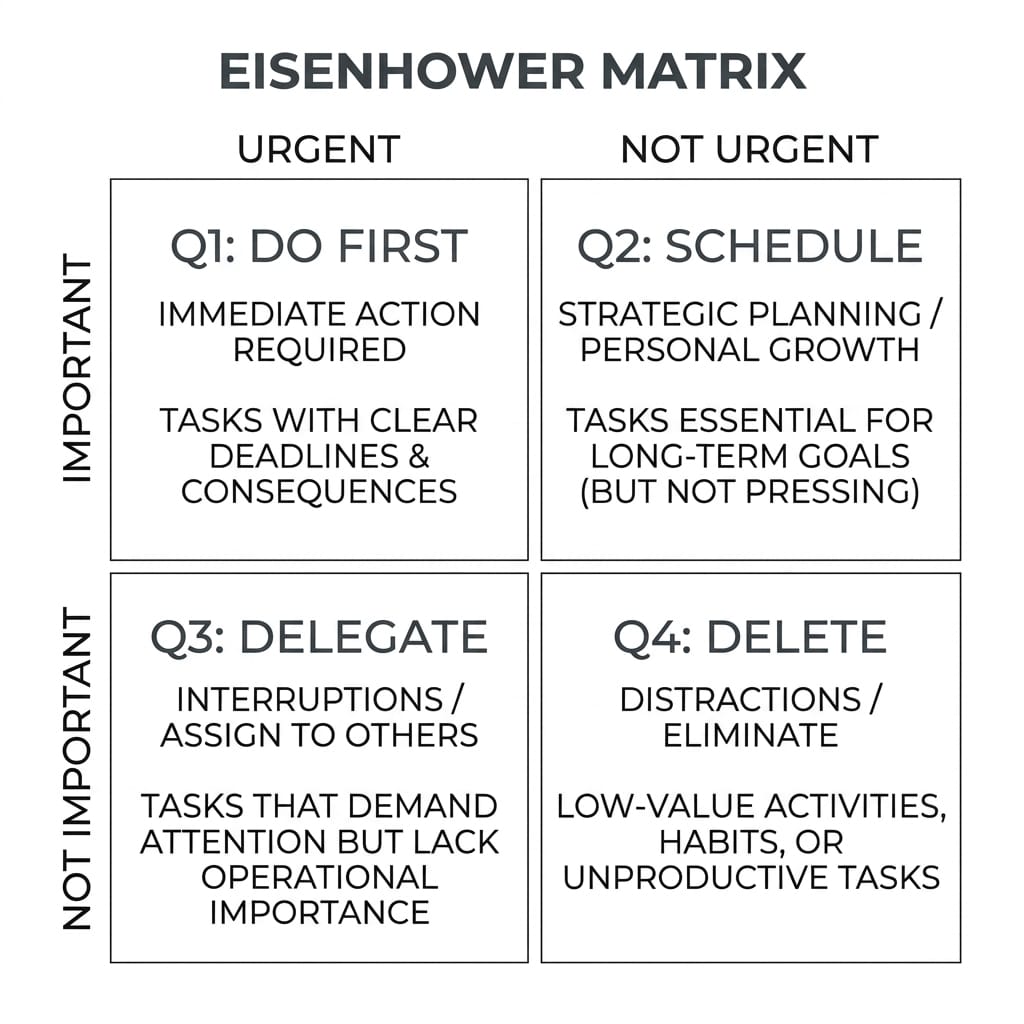
Seems simple right? Even so, I see many founders drowning in tasks that should be in Q3 or Q4.
And I will add that this is not a perfect solution, it doesn’t account for time or effort limitations of tasks, it also simplifies our biases. For instance, we are wired to prioritize tasks with tight deadlines over tasks with greater long-term rewards. Because of this we like to cram tasks into quadrant 1.
The matrix is a start to a decision-making structure; it’s a way you can question why you say yes or no to certain things.
Most founders find their week is dominated by the quadrant 3. Those tasks feel urgent because they arrive with a person attached, not because they matter. Quadrant 3 is where your reflexive yeses live, and it’s the fastest place to start handing work over.
Saying no to a big opportunity feels like a loss, and us humans are hardwired to avoid losing things, even when it holds us back. It might mean saying no to one market segment and prioritizing another that presents bigger and faster opportunities. Making these hard decisions is one of the biggest challenges of being an entrepreneur.
Go deep: Read Getting Things Done by David Allen. The book’s core idea is that your head is a bad place to store commitments. Capture everything that has your attention, decide what each item actually requires, and put it in a system you trust. That matters for a founder because every open loop in your mind is an unexamined yes, and it keeps nagging at you until you either do it, schedule it, delegate it or delete it. The book’s weekly review is especially useful here: it forces a regular moment to ask what you’ve committed to and what no longer deserves a place on the list.
2. You say yes to every decision going via you
If every decision routes through you, guess what?! You’ve said yes to being the only decision-maker! Gut feeling isn’t bad, and experienced founders often have good intuition. But gut instincts don’t scale.
Think about the last hiring, fundraising, or product call you made. Could you explain how you weighed it? If your team can’t see the logic, they can’t make similar calls without you, and every decision stays in your queue. A reusable way of weighing tradeoffs, even something as simple as three criteria and a weighting, turns your judgment into something a company can run on.
Tip: The next time an employee brings you a decision, stop yourself from answering. Instead ask, "If I were out of cell range for three days, what decision would you make?" Nine times out of ten, they already know the right answer. They just wanted you to carry the risk.
3. You say yes to work you’re not the best at
Founders often end up holding whatever nobody else picks up, and that’s rarely the work you’re strongest at. What part of your week gives you energy, and what part do you quietly dread? The dread list usually points to the gaps in your leadership team.
This is where “no” gets personal. Saying no to work outside your strengths means knowing what your strengths are, and building a team around the gaps instead of hiring people who mirror you.
Tip: I found the 51% rule a useful decision making tool to delegate work: if my team mate was 51% as good as me at the work, I'd delegate to them, and they will learn the remaining 49%.
4. You say yes again, after you’ve handed it off
Tsk tsk! This is the sneakiest one. You delegate, the task drifts, you’re impatient to see results, and you take it back “just this once.” Soon you’re doing it again.
Real delegation has an owner, a date, and a definition of done. Without those, you haven’t delegated. You’ve postponed the work to a moment when you’ll have to redo it under more pressure. In Michael E.Gerber’s book The e-Myth Revisited, he says this is the beginning of the end. Taking back work means more stress, a higher chance of burnout, and can lead to entrepreneurs closing their business.
Tip: Write a list of the things you’ve delegated in the last six months. How many are truly off your plate?
Score yourself
How many of these four felt uncomfortably familiar:
- You say yes to everything, so nothing is a priority
- You say yes to every decision going via you
- You say yes to work you’re not the best at
- You say yes again, after you’ve handed it off
One: You have a specific blind spot. It’s fixable, and probably faster than you think.
Two or three: You’re carrying a structural load. The company is leaning on you in more than one way.
All four: You’re the single point of failure, and you’re heading for, as they say in Australian, “destination f*cked!”
Why this matters more than it seems
Your attention is the most limited resource in your business. Every hour spent on something someone else could do is an hour not spent on a hiring, fundraising, or product decision that only you can make well. The cost is invisible because nothing visibly breaks. The decisions you don’t have time to think about simply come out a little worse, but that compounds.
All you need today is 20-minutes
1. Clarify (5 mins)
2. Audit (10 mins)
3. Act (5 mins)
Doing this reset once is easy. Not slipping back into "yes" next Tuesday when three fires break out is the hard part.
You don’t have a willpower problem, you have a Leadership Architecture problem. When your company doesn't have clear decision rules, ownership boundaries, and a deliberate "stop doing" filter, every problem naturally routes back to the founder.
Book a free 30-minute conversation with us. We’ll pressure-test your current setup, pinpoint where you’re a single point of failure, and give you an honest read on what needs to change first. If you want help installing those systems permanently, we’ll walk through our 12-week, 1:1 Leadership Architecture program, built to protect your runway by turning 'no' into a company habit.
Member discussion